Showing posts with label Entrees. Show all posts

Saturday, August 25, 2012

What I Did On My Summer Vacation


As I write this, I’m sitting at the pool in a lovely beach house in Kiawah Island, South Carolina.  It’s a gorgeous late afternoon and the only sounds I hear are the overhead fan, the crickets and the cawing of the many crows that live on this island.  The pool is sparkling and inviting … but it makes me sad because it’s empty.

For the past twelve days this place has been alive with family and friends and now they’ve all gone home.  It was a ton of work, but a lot of fun and I wish they were all still here.  Even if I did have to fry chicken for them.

Yep, you read that correctly.  I eff-ing fried 70 PIECES OF CHICKEN for my kids and their friends while they were here.   You’d think I had enough of that at Watershed and would welcome a vacation from it, wouldn’t you? 


We have stayed in this house at least half a dozen times before over the last seven or eight years.  It sleeps 12 comfortably, has that lovely pool, is only a short walk or bike ride from the beach and it has a fabulous kitchen.  Let me repeat that:  IT HAS A FABULOUS KITCHEN.  Given my kitchen-deprived state right now, you can guess where I chose to spend most of my time over the last two weeks.  Hence that fried chicken.

Here is the “recipe” if you can call it that.  It is based on Scott Peacock’s version of fried chicken in his book with Edna Lewis, “The Gift of Southern Cooking.”  It’s an adaptation of the method I use at Watershed.  Yes, it’s time-consuming, but you don’t have to be like me and overdo it (although I will say that those thirty-something “kids” managed to put most of those 70 pieces away).  The proportions I’m giving you are what I used, but you can scale it down.  Just keep the same ratio of flour to cornstarch in the dredge.

There are three steps to this process.  Two days before you are ready to fry, you must brine the chicken overnight.  The next day, you must drain it, then soak it in buttermilk overnight.  You will fry it on the third day.
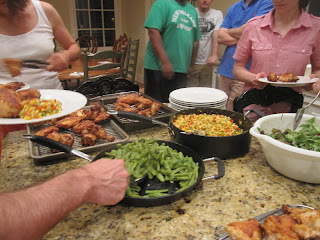
And then the hungry hordes will show up!


FRIED CHICKEN  (in the style of Watershed, Scott Peacock and Edna Lewis)

4 chickens, each cut into 8 pieces

For the brine:
1 gallon water (preferably filtered or spring water)
1 cup salt (I used kosher)

Stir water and salt together until salt is dissolved.  Two days before you want to fry, place the cut-up chicken into a large container and pour the brine over.  Cover and refrigerate until the next day.

For the buttermilk soak:
½ gallon buttermilk

Remove chicken from brine.  Place into a container large enough to hold it and pour buttermilk over.  Toss well to coat each piece then cover and refrigerate overnight.

For the “fry fat:”  (as Chef Joe Truex at Watershed calls it):
1 gallon peanut oil
1 lb. applewood smoked bacon, cut into 2-inch pieces
1 lb. unsalted European butter (such as Plugra)

Place all ingredients in a large stockpot over medium heat.  When butter melts and the mixture is hot (but not boiling), turn heat down as low as possible and let it simmer for 2 to 3 hours, stirring occasionally.  Strain into a large, heatproof container and set aside.  (If not using immediately, refrigerate overnight and bring to room temperature before proceeding).

For the dredge:
2 ½ lbs. all-purpose, unbleached flour (10 cups)
1 cup cornstarch
¼ cup kosher salt (4 tablespoons)
2 tablespoons freshly ground black pepper

Place all ingredients in a large tub or bowl.  Whisk to combine well.

To fry the chicken:  (Day Three)
Get the largest sauté pan you have.  Figure out about how many pieces of chicken it will hold without crowding, then set it over medium heat.  Add enough fry fat to come up to about a 1-inch depth and heat it to 325-degrees. 

In the meantime, dip only enough chicken pieces that the pan will hold into the dredge.  Toss them well to coat, then remove them one-by-one to a rack placed over a baking sheet, slapping each one well with your hands to remove excess dredge (as Chef Scott and Chef Joe like to say, you only want a “rumor” of flour on each one).  Less is more here, believe it or not.

When fry fat reaches the desired temperature, gently slip the chicken pieces skin side down into the hot fat.  They should be bubbling, but not too much.  You are looking for just a gentle bubble, so you know it is cooking, but not too fast.

After about 10 minutes, start checking to see if the pieces are golden on the bottom side.  If so, use tongs and a spatula to gently turn them to brown the other side.  If not, let them go until they release from the pan and are golden.  Once turned, each piece should take another 5 to 10 minutes.  Don’t crowd them and don’t rush them.

As chicken pieces are done, use tongs to remove them to a rack set over a baking sheet.  When all pieces have been removed, you must drain the fat from the pan into a strainer set over a heatproof bowl, then wipe out the pan so that no browned or burned bits remain (sometimes it helps if you use a little hot water, then scrape up any bits and wipe the pan well with a dish towel). 

Return pan to the heat, pour the strained fry fat back in, bring it back to temperature and then proceed with your next batch of chicken.  Repeat this process until all pieces are fried.  (If you are crazy like me and are doing a ridiculous number of pieces, then you should use new fry fat after about the third batch or so).

Yield:  32 pieces


At the restaurant, we make our fry fat with a combination of lard, smoked pork shoulder (or country ham) and Plugra.  That's great if you want to render your own lard (don't even think about using that boxed hydrogenated stuff you find on the grocery store shelves), but if not, peanut oil works just fine.  I have also found that applewood smoked bacon is a good substitute for the pork shoulder or country ham.

When it comes to the oil temperature, I don't use a thermometer.  I just sprinkle a little of the dredge mixture into the pan when I think it's hot enough.  If it produces a few bubbles, then your pan is ready for the chicken.

Here's the biggest tip:  you don't have to fry your chicken at the last minute so you can make sure it is hot and crisp.  Just keep it on that rack until you are ready for it, then transfer it to a baking sheet and slip it into a 425-degree oven for about 10 minutes.  It will emerge hot and crispy and no one will ever know that you did not fry it up for them at the very last minute.


So now you know that this is truly a labor of love.  Some would debate whether or not it is worth the work.  It is to me, when I hear the compliments from our guests at Watershed or, more importantly, when my kids and their friends heap on the praises and scarf down enormous quantities of it.  But here’s my dirty little secret … I would never fry this stuff in my own kitchen.

Thank you, beach house!


Thursday, December 16, 2010

ABT

Anything but turkey.


I’ve been doing a lot of recipe testing this week (for that book I’m collaborating on) so it’s been a bit like Thanksgiving around here. Translated, that means a lot of poultry, as in a great big roasted turkey. Now this would be great if I still had a houseful of kids but since it’s only Henry and me …. well not so much. As good as this recipe (with its accompanying gravy) was, I’m pretty sick of the stuff. Suffice it to say, I will not be making turkey on Christmas Day.

Yesterday I decided that I couldn’t face it once again for dinner. I hit the gym, then stopped at Whole Paycheck Foods on the way home to pick up something for dinner. It was cold, the streets were supposed to ice up later and something braised and comforting was on my radar screen. I was also feeling virtuous (since I had worked out), so I figured red meat or an extra fat gram or two wouldn’t kill me.

I ended up with lamb shanks. They didn’t break the bank and I knew they would fill the house with a lovely smell and a savory aroma. It was early enough in the day that I could set them on the stove and slowly cook them for a few hours until they were meltingly tender and infused with flavor.


Once home, I thought about unearthing a recipe, but I was too lazy. I just winged it. Here is the result, and it was delicious.  I served it on a lovely bed of cannellini beans, lightly tossed with good extra-virgin olive oil, fresh lemon juice and chopped rosemary, then seasoned with kosher salt and freshly ground black pepper.

LIZ'S LAMB SHANKS

4 lamb shanks
1 tablespoon olive oil
1 large onion, cut into small dice
2 cloves garlic, minced
1 carrot, cut into small dice
1 stalk celery, cut into small dice
1 cup dry red wine
2 tablespoons tomato paste
1 28-oz. can diced tomatoes (San Marzanos preferred)
¼ cup red wine vinegar
4 sprigs fresh thyme
2 sprigs fresh rosemary
1 fresh bay leaf
2 cups beef stock
½ cup pitted and chopped Kalamata olives
¼ cup chopped Italian parsley, for garnish

Pat lamb shanks dry. Heat oil in a large sauté pan or dutch oven and add shanks. Brown on both sides until golden. Remove to a plate and set aside.

Reduce heat to medium-high, add diced onion to the pan and sauté for 5 minutes. Add garlic, carrot and celery and continue to cook until vegetables are just tender, another five minutes or so.

Pour wine into pan and deglaze over high heat. Stir in tomato paste and diced tomatoes with their juice. Bring to a boil then add vinegar and herbs. Add stock and browned lamb shanks. Season with salt and pepper. Once mixture boils, reduce heat, cover and simmer over very low heat for about three hours, or until meat is very tender and almost falling off the bones.

Just before serving, remove herb stems and stir in the Kalamata olives. Taste the sauce and add salt and pepper if needed. Serve the lamb shanks over a bed of white beans, mashed potatoes or polenta, topped with plenty of the sauce and a sprinkling of chopped Italian parsley. A bottle of good red wine served with this wouldn’t be a bad thing either!

Serves 4


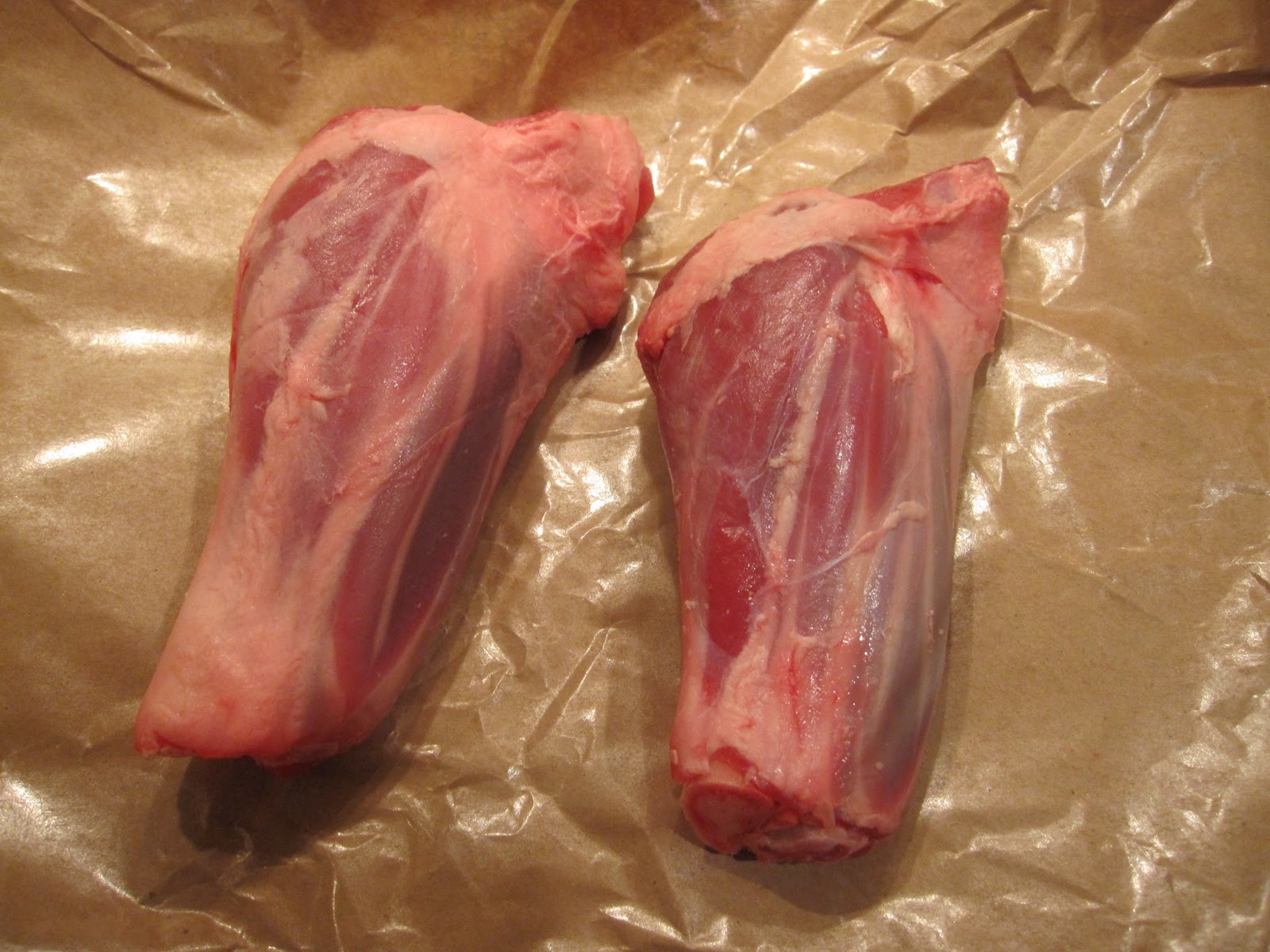
Note: I hate it when I look at a cookbook and the photos don't match the description of the recipe.  Like maybe they have added a garnish or something to make it look really good and there is no mention of it in the directions.  It really pisses me off.  So in the interest of full disclosure, I made this with only two lamb shanks as pictured (I mean, only two of us live in this house these days, right?)  Nonetheless, the proportions I gave you in this recipe are enough for four shanks. 

Henry, I hope you like leftovers, because you get to eat this again tonight. At least it isn’t turkey!

Monday, December 6, 2010

Dinner by Default


You know the drill. You leave town for a couple of days and before you depart, you maniacally clean out the refrigerator and the produce bin. Heaven forbid a lemon should be left out to rot while you are absent! (Well, maybe I’m justified here – remember those fruit flies?)

http://nevertrustaskinnycook1.blogspot.com/2009/09/windex-and-amaretto.html

So you leave the house and head to the airport, secure in the knowledge that your house has been left in good order, the timers are set to turn lights on and off and you won’t come home to the smell of decaying citrus or the sight of blackened cottage cheese. All is well and off you go on your trip with nary a thought about what on earth you are going to do about dinner on the evening you return.

But then, of course, you come home to NOTHING IN THE HOUSE. You’ve been traveling all day and the last thing you want to do is head out to the grocery store. Maybe a pizza delivery is in order. Well, maybe not. You’ve probably consumed enough junk on your trip to last for the next three months, so the last thing you can justify is a pizza, loaded with carbs and oozing with fat. Scratch that idea.

The answer to this conundrum is Penne alla Vodka. If you are like me, you have everything you need to make it in your pantry (okay, maybe not the vodka but if you are like me, you will have it somewhere in the house). It’s easy, it comes together in minutes and it’s really, really good. So good, in fact, that you will never miss that pizza!  Besides, it has vodka in it.  How bad could it be?


PENNE ALLA VODKA

2 tablespoons olive oil
2 large cloves garlic, chopped
1 28-oz. can diced tomatoes (San Marzanos, if possible)
½ teaspoon red pepper flakes (or more to taste)
Kosher salt and freshly ground black pepper to taste
16 oz. whole wheat penne*
2 tablespoons vodka
½ cup heavy cream

Heat the olive oil over medium heat in a very large sauté pan. Add garlic and cook for 1 minute, or until it just starts to give off a wonderful aroma. (Do not let it burn). Add the tomatoes with their juice and season with the red pepper flakes, kosher salt and black pepper. Bring mixture to a low boil, then reduce heat and simmer for 10-15 minutes to allow flavors to marry.


Meanwhile, bring a large pot of generously salted water to the boil. Add the pasta and cook, stirring often, until pasta is just done, 15 to 20 minutes. Drain well and add to the simmering sauce in the pan. Stir in the vodka and the cream. Season again if needed and cook for another 5 minutes or so until vodka evaporates slightly.

It’s nice to serve this with a little chopped parsley, but you probably don’t have any since you cleaned out your refrigerator. No worries, it’s good enough without it!

Serves 4 - 6

*I would urge you not to turn up your nose at whole wheat pasta.  It's delicious and it's good for you.  In truth, I prefer it to the "white bread" variety of pasta.  It has more of a bite and a rustic quality that I think adds a lot to the dish.  It does take a little longer to cook, so factor that in, but don't be afraid to serve it to your family or friends.  If they are like mine, they won't know the difference.  Trust me!


*Regular old canned tomatoes will do, but if possible, try to get your hands on some San Marzanos.  Most grocery stores carry them these days and it's worth seeking them out.


*I have been known to serve this to company. They never knew it was a desperation dinner!

Monday, November 8, 2010

My Latest Obsession

You know what that means.  Ingredient overload.  Fortunately for you guys, I used up all of those hazelnuts (sorry, Henry), so you don’t have to hear about them again for awhile. Unless, of course, you want my recipe for mushroom, artichoke and hazelnut salad.

For now though, I’m focused on preserved lemons.

Have you ever had preserved lemon? Not out of hand (who would do that anyway), but in a dish such as a Moroccan tagine? It adds a big “wow” factor and a lovely depth of flavor. The best way I can describe it is intense lemon flavor multiplied by the power of ten.

I recently made them to use in a chicken and olive tagine, which is a pretty classic combination. The dish was delicious, but I ended up with more preserved lemons that I knew what to do with. Now what?

What” turned out to be using them in a roasted zucchini dish. I made a big batch of the stuff the other night and served it with grilled bison burgers (c’mon, it was a weeknight and I was slopping the hogs). The good news is that I had enough left over to eat for breakfast the next two days. (I know, I have weird breakfast preferences, but we’ve already discussed that, so let’s not go there again!)

The next “What” was stirring them into couscous, along with some scallions, toasted pine nuts and chopped Italian parsley. I served this with cedar-planked King salmon and ka-ching! Another winner.

Oh, but I’m not done. I haven’t told you about the shrimp and rice yet, possibly the most delicious dish of all.

See, I told you I was obsessed!  "What?"


PRESERVED LEMONS  (from Gail Arnold and Ina Garten)

3 lemons
2 tablespoons kosher salt

Preheat oven to 250-degrees.


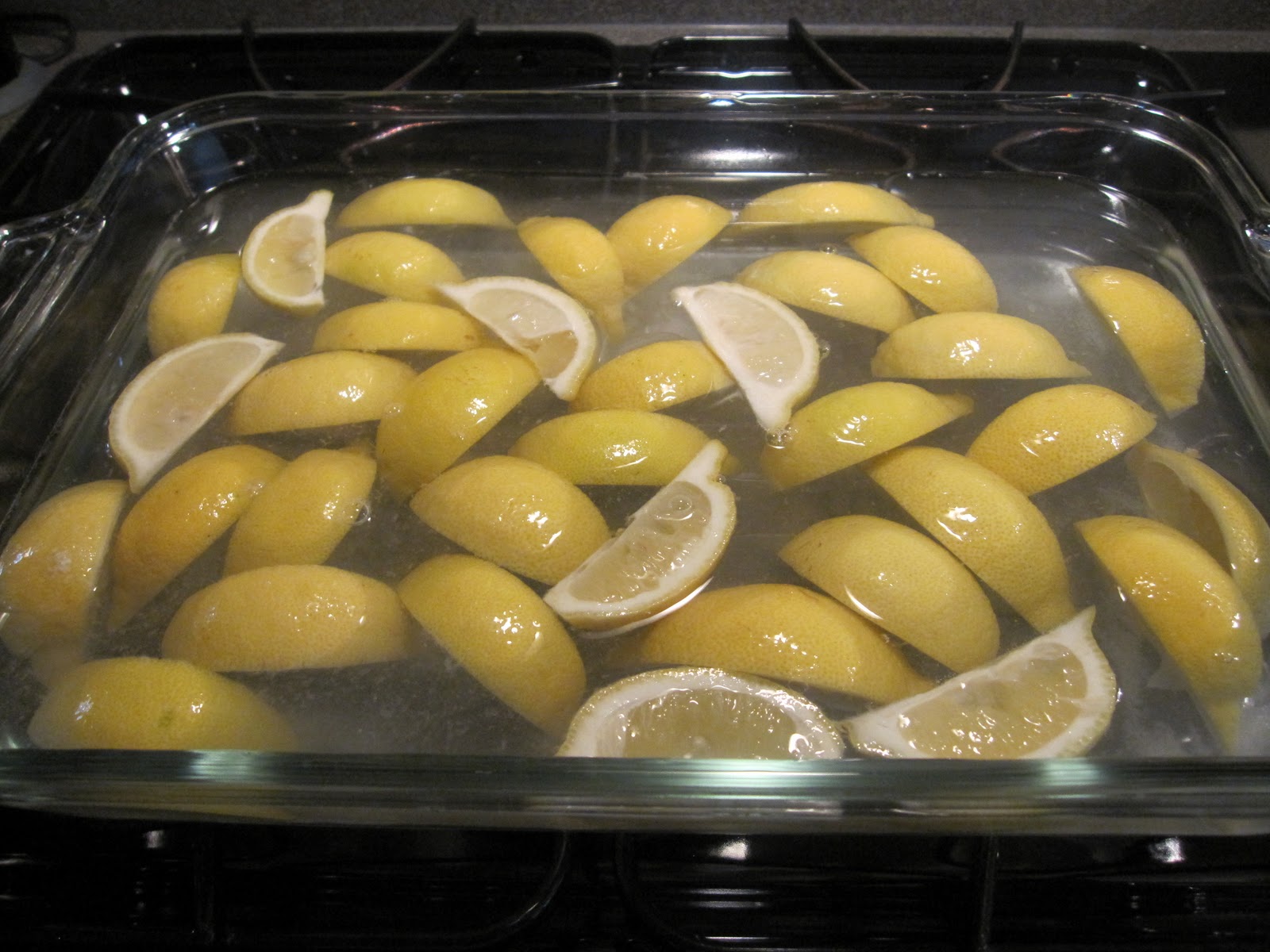
Wash lemons and cut in half lengthwise then cut each half lengthwise into thirds.  Place in one layer in a large baking dish (I used a 13 x 9 x 2-inch Pyrex) and sprinkle with the salt.  Add enough water to cover and bake for 3 hours.


Remove from oven and allow to cool.  Place lemons in a wide-mouth quart glass canning jar and pour in enough of the liquid to cover.  Screw lid on top and refrigerate.

These can be stored in the refrigerator for up to 6 months.


Yield:  18 wedges


ROASTED ZUCCHINI WITH PRESERVED LEMON AND OREGANO (adapted from Beau MacMillan)

4 to 5 medium zucchini
2 tablespoons extra-virgin olive oil
Juice and zest of 1 lemon
2 cloves garlic, minced
1 shallot, minced
2 tablespoons chopped Italian parsley
2 tablespoons chopped fresh oregano
Kosher salt and freshly ground black pepper to taste
½ cup pitted and chopped Kalamata olives
1 wedge preserved lemon, rinsed and chopped (including rind)

Preheat oven to 375-degrees. Place a roasting pan in oven to preheat.

Slice zucchini in half lengthwise then cut across into thirds. Place in a bowl and toss with the olive oil, lemon juice and zest, garlic, shallots, parsley and oregano. Season well with salt and pepper.

Remove the hot roasting pan from the oven and add the zucchini mixture, spreading it out in one layer. Return to oven and roast for 5 minutes. Stir in the Kalamata olives and roast for an additional 4 to 5 minutes or zucchini is just tender. Serve immediately.

Yield: 4 – 6 servings


PINE NUT AND PRESERVED LEMON COUSCOUS  (adapted from Emeril Lagasse)


2 cups couscous
2 cups chicken or vegetable stock
2 tablespoons butter or olive oil
1 cup chopped scallions
Kosher salt and freshly ground black pepper to taste
1 cup pine nuts, toasted
1 wedge preserved lemon, rinsed and chopped (including rind)
2 tablespoons chopped Italian parsley

Place couscous in a wide bowl or shallow pan. Bring stock to a simmer and pour over the couscous. Cover and let sit until liquid is absorbed, about 5 minutes.

Meanwhile, melt butter (or heat oil) in a small sauté pan over medium heat. Add scallions and season with salt and pepper. Sauté for 1 minute, then add to couscous along with pine nuts, preserved lemon and chopped parsley. Use a fork to fluff well and blend all ingredients. Taste to adjust seasonings.

Yield: 4 – 6 servings


SHRIMP AND RICE PILAF WITH SAFFRON AND PRESERVED LEMON (adapted from the Food Network)

3 tablespoons olive oil, divided
1 medium onion, chopped
3 cloves garlic, minced
1 teaspoon saffron threads
Kosher salt and freshly ground black pepper to taste
1 cup brown rice
2 ½ cups chicken or vegetable stock
1 15-oz. can diced tomatoes
½ teaspoon cayenne pepper (or more to taste)
½ cup chopped and pitted green olives
1 pound medium shrimp, peeled and deveined
1 wedge preserved lemon, rinsed and chopped (including rind)
Chopped Italian parsley, for garnish

Heat 2 tablespoons of the olive oil in a medium saucepan over medium-high heat. Add the onion and cook for 3 minutes or until soft. Add garlic and saffron threads and cook for 1 minute more. Season with salt and pepper, then add rice and sauté, stirring constantly for 2 minutes. Add the stock, cover the pot and lower heat to simmer. Cook for about 45 minutes, or until rice is tender.


Meanwhile, heat remaining olive oil in a sauté pan. Add tomatoes and cayenne pepper and cook for 5 minutes until liquid reduces slightly. Add the olives, shrimp and preserved lemon. Cook over medium heat until shrimp turns pink and starts to curl slightly, 3 to 5 minutes. Do not overcook. Season with salt and pepper.

Add rice mixture to shrimp in sauté pan and stir to blend. Taste to adjust seasonings. Turn into serving bowls and garnish with the chopped parsley.

Yield: 6 – 8 servings

• You can make this with white rice, if desired (although I like brown rice better for its texture and healthier qualities). If using white rice, decrease cooking time to 20-25 minutes.
• This recipe is somewhat “paella-like.” To make it more so, you could add chunks of cooked sausage and/or chicken.
• And yes, saffron is expensive. If you can’t bring yourself to buy it, you can substitute  turmeric (poor man's saffron). A little smoked paprika or pimenton would be good in this dish also.

Whew!  I'm done now.  Enough recipes for now?

Monday, October 18, 2010

Weekend Food

My idea of a perfect Saturday goes something like this:  hit the gym in the morning for a step or spin class, get sweaty and exhausted, come home, shower, go out for a nice lunch with Henry, run a few errands, wander around Whole Foods or Fresh Market to decide what's for dinner then come home and cook while watching the Food Network and/or old reruns of "The Sopranos."  Exciting life, huh?

But that's when I enjoy my (crappy) kitchen most - when I can take my time and make what I feel like, as opposed to throwing together a quick weeknight dinner.  In the case of this past Saturday, that meant crabcakes!


As usual, I got overly ambitious and decided to make a chocolate hazelnut pie as well (for an upcoming hazelnut blog post, stay tuned).  Oops, but what happened to the pie crust dough I thought I had in the freezer?  Oh wait - I threw it out a few weeks ago.  That meant making and chilling a brand new batch and by the time I got the thing in the oven, it was almost 7:30.  Oops, again.

So dinner may have been a little late that evening, but it was worth waiting for.  I served those lovely crab cakes with silky mashed potatoes and lightly steamed baby carrots with butter and fresh dill.  We polished off a bottle of Hendry rose, sat outside on our front porch and declared that we would definitely order this again.


These are the crabcakes we used to make when I worked at Watershed.  It comes from Scott Peacock and the recipe is in his book with Edna Lewis, "The Gift of Southern Cooking."  The quantities I use here are slightly different from the ones called for in his book, but this stretches the recipe a little bit and the results are equally as tasty (at least I think so).  I always make the entire recipe which yields 12 crabcakes so I can keep some in my freezer.  Then I can trot them out for a quick weeknight dinner or give myself a break from Saturday cooking and take a nap instead!

CRABCAKES

1 small loaf good quality bakery white bread, unsliced
1 pound lump crabmeat, carefully picked over
1 medium onion (preferably Vidalia), finely chopped
1 bunch scallions, white and green parts, thinly sliced then minced
Juice of 1 lemon
4 eggs, lightly beaten
1/2 cup melted unsalted butter
Kosher salt, freshly ground black pepper and ground cayenne to taste
3 T. vegetable or canola oil
1 T. unsalted butter

Trim crusts from bread and cut bread into 1-inch chunks.  Place on a baking sheet in one layer and bake in an oven preheated to 350-degrees for 15-20 minutes until just golden, turning once.  Set aside to cool, then grind to fine crumbs in a food processor.  Measure out 2 cups and set aside.

In a large bowl, combine the crabmeat, chopped onion, minced scallions, lemon juice, eggs and butter.  Stir in the reserved 2 cups of bread crumbs.  Season to taste with salt, pepper and cayenne.  Mix lightly with your hands until all ingredients are incorporated but do not overhandle.

Scoop out mixture and form lightly into cakes.  (I used a 2 1/2 oz. ice cream scoop for this).  Place on a baking sheet and refrigerate for at least 30 minutes.

In a large saute pan, heat oil and butter over medium heat.  When pan is hot, add desired number of crabcakes and cook until just golden on one side (about 4 minutes) then turn and brown on the other side.  Serve immediately with lots of lemon wedges and (my recommendation) mashed potatoes.

Yield:  12 crabcakes

As I mentioned, you can freeze any crabcakes you don't use for another time.  Same goes for the bread crumbs - keep them in a ZipLoc bag in your freezer and use them as needed for other dishes.

Friday, October 8, 2010

Complete Fake-Out


I am not a vegetarian.  Oh, I'll admit that I once was - a very long time ago - for a very short time.  It had something to do with prepping raw chicken for 500 back in my catering days.  But eventually I succumbed again to the dark side, back to burgers, rib-eyes and that old favorite, bacon.

Several weeks ago we were working on that "cookbook I can't tell you about" and when the photo shoot was done, we gorged ourselves on wood-roasted fois gras with figs and beautifully grilled dry-aged steaks.  Pig heaven (well, more like goose and cow).  Thank goodness my (non-existent) scruples didn't get in the way of the fabulous-ness on that table!

Still, I can be content with just vegetables in front of me.  I can't think of any I don't like, and they are constant visitors to my dinner plate.  Particularly if they are roasted.  Did you know that roasted brussels sprouts are almost as good as french fries?  (In truth, they are just a vehicle for salt).  Roasted cauliflower is pretty awesome, too.  Or a whole head of cauliflower microwaved for 10 minutes then slathered all over with dijon mustard, topped with shredded sharp cheddar and nuked again for about a minute until the cheese melts.  That's what I made last night and I will admit to polishing off the leftovers for breakfast this morning. 

So I am never unhappy when invited to my vegetarian friend's house for dinner (Linda, you know who you are).  She is a great cook and she has taught me a few tricks, like her lentil loaf and vegetarian chili.

And that is what I want to share with you - Linda's Vegetarian Chili.  It's delicious, it's healthy and no one will ever know it's meatless, unless you tell them.  I made a big batch of it the other day (remember, it's autumn and I'm into that kind of cooking), served it to Henry and he didn't have a clue.  Guess I should have kept my mouth shut.


I like it served over rice with a dollop of sour cream.  In my nod to trying to become a skinny cook one of these days, I served it over brown rice (cooked with chicken stock, so much for my veggie efforts) with a spoonful of nonfat, local "Greek" yogurt.  Virtuous, yet delicious.

This recipe makes a lot, but do what I did:  eat it for dinner, save enough for a couple of lunches at home and freeze the rest.  You'll be glad you did when you drag it out on a cold winter's evening and can enjoy it without any real cooking that night.  A glass of decent red wine with it won't hurt, either.


LINDA'S VEGETARIAN CHILI

3 tablespoons olive oil
2 onions, chopped
8 stalks celery, chopped
2 red peppers, chopped
2 green peppers, chopped
3/4 lbs. mushrooms, rough chopped
4 cloves garlic, chopped
2 28-oz. cans diced tomatoes
2 15-oz. cans kidney beans, drained and rinsed
Kosher salt and freshly ground black pepper to taste
Red pepper flakes, to taste
1 tablespoon chili powder
1 1/2 tablespoons ground cumin
1/4 teaspoon cinnamon
1 tablespoon dried basil
1/2 tablespoon dried oregano
1/2 tablespoon marjoram
2 12-oz. bags Morningstar Farms "meat" crumbles
1 12-oz. bottle of beer (I used Heineken), optional
Cooked brown rice and greek yogurt or sour cream for serving

Heat the olive oil in a large pot or dutch oven over medium-high heat.  Add onions and celery and saute until fragrant and vegetables start to soften.  Add red and green peppers and continue to cook until peppers start to soften.  At this point, it is a good idea to season well with salt and pepper.

Add mushrooms (portobellos or criminis are good for this dish as they are "meaty") and garlic; continue to cook for 5 minutes more or until mushrooms start to give off their juice.  Add tomatoes and kidney beans then season to taste with more salt and pepper, the red pepper flakes, chili powder, cumin, cinnamon, basil, oregano and marjoram.  When mixture starts to bubble, add the crumbles, cover the pot and lower the heat.  Simmer until chili thickens slightly and flavors start to meld, about 30 minutes, stirring frequently so chili doesn't scorch on the bottom of the pot. 

Add the beer, if using, and continue to cook, uncovered, until most of the alcohol evaporates, about 20 minutes.  Taste to adjust seasonings and serve in a large bowl over (brown) rice and a dollop of yogurt or sour cream.

 
Serves 12
Now don't turn up your nose at those Morningstar Farms "meat" crumbles.  They give this chili the right texture and just think of all the fat and calories you're saving!  You will find them in the freezer section of your grocery store.  If you just can't bring yourself to use them, you could always substitute ground bison for a low-fat meat version of this dish.  Your choice!


Since we are heading to Hugh Acheson's new restaurant in Atlanta tonight for dinner, I'm thinking my lunch today will be a nice bowl of this guilt-free chili!  I'll make up for it tonight, I'm sure!

http://empirestatesouth.com/

Wednesday, October 6, 2010

Dinner Party

Henry and I love to entertain, however, I am not one to throw a formal dinner party.  If you've been reading this blog for awhile, you probably know that my style is low-key and casual, as in wear your shorts or blue jeans, I'll throw something on the grill and we'll most likely eat outside on the patio.  It won't be fancy but we promise we will feed you well and there will be no shortage of beer, wine or alcohol!

When autumn arrives though, my preferences change.  Grilling gives way to slow-simmered aromatic braises, salads go from juicy ripe tomatoes with fresh mozzarella and home-grown basil to lettuces adorned with warm goat cheese, desserts morph from light and fruity concoctions to things like apple-studded spice cake or gingerbread, Stilton and port make their re-appearance and we might, just might even serve dinner at the dining room table.  Nonetheless, it won't be stilted or stuffy.  Not in my house!

So when we invited friends over for dinner recently, I had visions of a lovely leg of lamb upon a bed of white beans fragrant with rosemary, set smack dab in the middle of the table so that everyone could help thenselves.  Repeatedly.

Fortunately (to my great dismay), I discovered ahead of time that one of my guests could not eat red meat, pork or seafood.  Crap.  That meant chicken.  I ate enough grilled chicken with lemon-pepper-shallot butter over the summer to last a lifetime.  Lamb, I wanted lamb!

Once I got over myself, I turned to the task of creating a menu.  I decided upon that old fave, "Chicken with 40 Cloves of Garlic."  Well, until I consulted my handwritten menu files.  (Yep, I keep a record of everything I've served to guests in my home for the last 15 years or so.  How sick is that??  Haha, if you've ever had a meal here, I'll bet I can tell you what you ate!)  But in this case, it served me well because I discovered I had made this dish for these same guests a couple years ago.  Crap again.  Back to the drawing board....

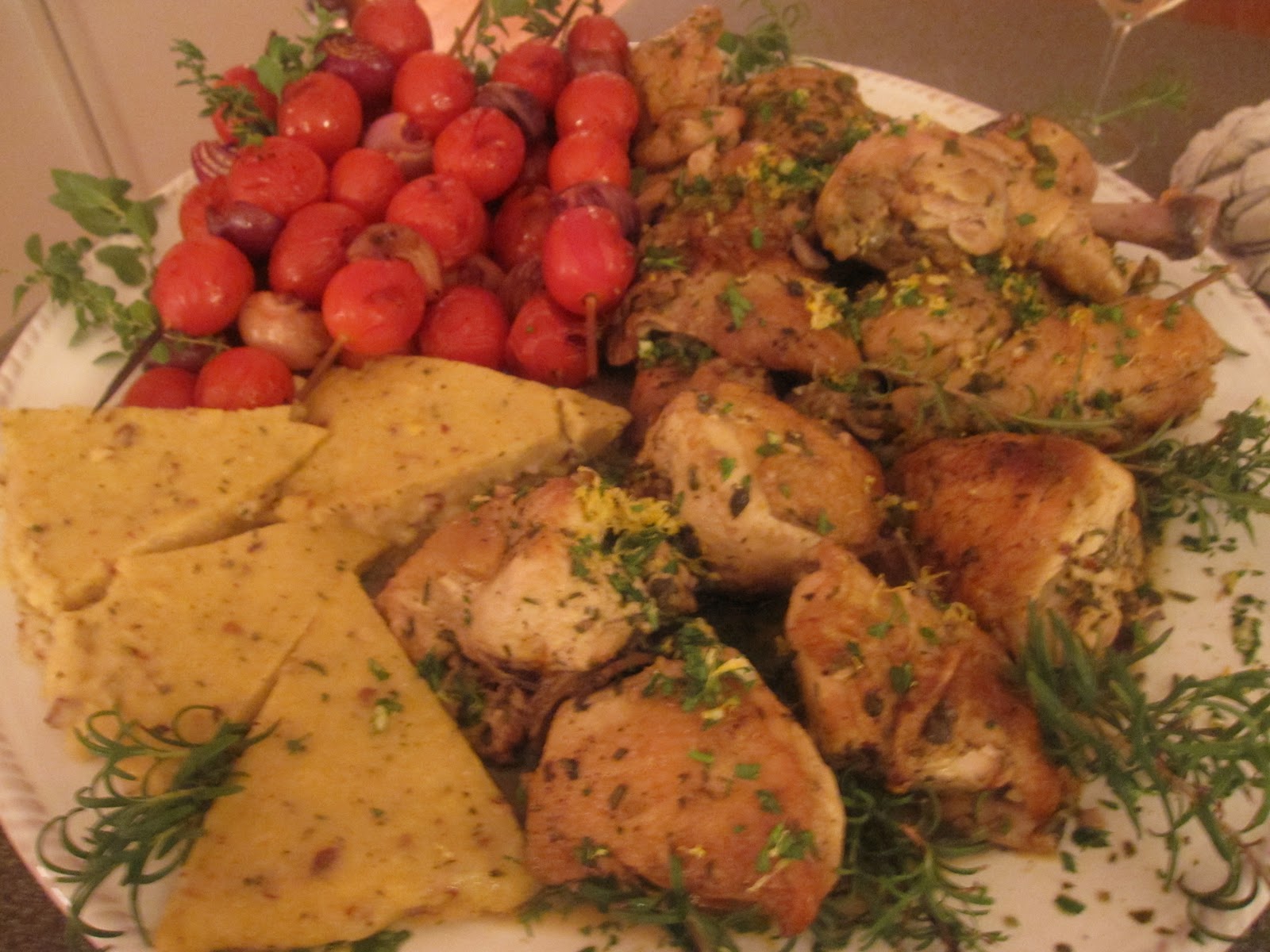
Then I remembered "Donna Siebert's Roman Chicken" that I used to make.  It comes from Nathalie Dupree (remember her?) and I got it from a cooking class I took from her back in the late eighties (yikes).  This dish is packed with flavor and I have never served it without a request for the recipe.  It is also better if made ahead which is a big plus if you ask me.

Here is my menu:

Radishes with European Butter
Hawaiian Pink Sea Salt, Australian Flake Sea Salt,
Ocean Smoked Sea Salt, Truffle Salt

Rosemary-Pine Nut Popcorn

*****

Donna Siebert's Roman Chicken

Dick Simpson's Polenta
Pecans, Gruyere, Rosemary

Grape Tomato and Red Onion Skewers
Short-smoked

*****

Vanilla Buttermilk Panna Cottas
Strawberry/Rose Wine Sauce
Oatmeal Lace Cookies

*****

English Toffee with Fleur de Sel

Now, you already have three of these recipes.  Here are the links, so you can reference them again:

Rosemary-Pine Nut Popcorn

Oatmeal Lace Cookies

English Toffeee with Fleuer de Sel


For the radishes, just clean them well and set them out with the softened (unsalted) butter and small ramekins of the assorted salts.  The idea is to douse them with a little butter then dip into the salt.  People love this and it always inspires debate about which salt reigns supreme.  Great convo starter, too!


DONNA SIEBERT'S ROMAN CHICKEN (adapted from Nathalie Dupree)

For the chicken:
3 tablespoons olive oil (may need more if doing chicken in batches)
3 lbs. chicken pieces, bone-in with skin
Salt and freshly ground black pepper
4 cloves garlic, chopped
1/2 cup chopped fresh rosemary, divided
1 cup dry white wine
2 cups chicken stock
Red pepper flakes, to taste
1 small jar of capers
1 tablespoon anchovy paste
1 tablespoon fresh oregano, chopped
1 cup good red wine vinegar

For the garnish:
1/2 cup chopped Italian (flat leaf) parsley
2 cloves garlic, minced
Zest of 2 lemons, minced

Heat the olive oil over medium-high heat in a large saute pan.  Season chicken well with salt and pepper and add to the hot pan, skin side down.  When golden brown, turn and brown on the other side.  Do not crowd the pan; you may need to do this in several batches.  Remove chicken from pan when browned; reserve.

Increase heat to high and add garlic, 1/4 cup of the rosemary and wine to the pan.  Bring to a boil and reduce by half.  Add the chicken stock and red pepper flakes to taste and reduce slightly; about 10 minutes.  Add reserved chicken and capers, reduce heat to low, cover and simmer until chicken is tender and falling off the bone, 45 minutes to 1 hour.

Meanwhile, combine the anchovy paste, oregano, remaining rosemary and red wine vinegar.  When chicken is done, remove to a platter and cover with foil.  Add the red wine vinegar mixture to the pan, increase heat to high and boil until reduced by half.  Taste to adjust seasoning.  Return chicken (and accumulated juices) to pan to heat through.  Place on a serving platter, pour pan juices over and sprinkle with the garnish.

For the garnish:
Combine chopped parsley, garlic and lemon zest.  Sprinkle evenly over chicken.

Serves 4 - 6


DICK SIMPSON'S POLENTA

(Dick Simpson is my dear friend in Tampa whose birthday party we attended last June. He prefers to be called Richard, but I've known him way too long for that.   He's a fabulous cook and this is his recipe for polenta.  It rocks.  His recipe calls for walnuts, but I use pecans.  Either will work.  Once you make this, you will never make plain old polenta again.  Oh, and you get to make this in advance also.  Way to go, Dick Richard!)

4 cups chicken (or vegetable) stock
1 cup yellow cornmeal
1 teaspoon kosher salt
4 tablespoons unsalted butter
1/2 cup chopped, toasted pecans
2 tablespoons minced fresh rosemary
1 cup finely grated Gruyere cheese
Salt and freshly ground black pepper to taste

Bring stock to a boil in a medium saucepan.  Using a whisk, slowly add cornmeal, whisking constantly until dissolved.  Add the 1 teaspoon of salt, lower heat to medium-low and continue cooking for 10 - 15 minutes, whisking frequently until mixture is thickened and all liquid is absorbed.  Add the butter, pecans, rosemary and Gruyere.  Add salt and pepper to taste, then spread mixture into a greased 9-inch pie plate.  Cover and chill.

When ready to serve, cut into eighths.  Preheat oven to 350-degrees.  Places wedges on baking sheet and bake for 15 minutes or until just warmed through.

Serves 8 (or 6 if you cut really big wedges)


GRAPE TOMATO AND RED ONION SKEWERS

For each skewer:
4 cherry or grape tomatoes
2 pieces red onion
Olive oil
Salt and freshly ground black pepper to taste

Thread tomatoes and onions onto each skewer.  Brush each one with olive oil and season well with salt and pepper.

Fire up your grill and place a few wood chips over the coals.  Grill skewers, turning once until tomatoes are just cooked through but not bursting, about 5 minutes.


VANILLA BUTTERMILK PANNA COTTAS (adapted from Claudia Fleming's "The Last Course")

For the panna cottas:
1 tablespoon cold water
1 1/2 teaspoons unflavored powdered gelatin
1 1/4 cups heavy cream
7 tablespoons granulated sugar
1 tablespoon vanilla paste
1 3/4 cups buttermilk

For the sauce:
1 1/2 pints strawberries, hulled'
1/4 cup granulated sugar
1 bottle rose wine

For the panna cottas, place the water in a small bowl and sprinkle with the gelatin.  Let soften for 5 minutes.

In  saucepan over medium-high heat, warm the cream with the sugar and vanilla paste, stirring until the sugar dissolves.  Turn off the heat and add the softened gelatin.  Stir until dissolved then whisk in the buttermilk.  Strain into a measuring cup with a spout then pour into six 8-oz. ramekins.  Chill until firm, at least 3 hours or preferably overnight.

For the sauce, combine the strawberries and sugar in a bowl and let stand for 30 minutes to let juices develop.  Place this into a saucepan, add the wine and bring to a simmer over medium heat.  Reduce heat to low and simmer until most of the alcohol is cooked off, about 1 hour.

Strain through a cheesecloth-lined sieve.  Do not press on the solids; allow the liquid to drain slowly.  Discard the berries and use the sauce to serve with the unmolded panna cottas.

Serves 6

Couldn't decide what size to make.  In the end I served the larger.
More to enjoy!

Maybe I have just a few too many of these things!

Note:  in the interest of full disclosure, I added gelatin to the sauce.  I unmolded the panna cottas into wide serving glasses (those would be my margarita glasses!) then poured the sauce around it and set in the fridge to solidify.  It made a gorgeous presentation but personally, I didn't like the texture.  Next time I'll just stick with the sauce.

I think this is the longest blog I have ever posted.  Sorry, everyone!  That said, I hope you make and enjoy some of these recipes.  Here's to your next dinner party!